
Almost everyone who walks into our office on Main Street has done it. You feel that tight, stuck sensation at the base of your skull, you twist your head hard to one side, something pops, and for about ninety seconds the world is a better place. Then it comes back, so you do it again.
People usually ask about it sheepishly, as though they are confessing something. They are not. It is one of the most common questions we get, and the honest answer is more interesting than a simple yes or no.
What Is Actually Happening When Your Neck Pops?
The pop is called a cavitation. Your spinal joints are surrounded by a capsule containing fluid, and dissolved in that fluid are gases. When the joint surfaces separate quickly, the pressure inside drops and those gases come out of solution with an audible release. It is the same physics as opening a can of soda.
Two things follow from that. First, the noise itself is not the point. It is a by-product, not a measure of whether anything useful happened. Second, a joint that has just cavitated cannot do it again for roughly twenty minutes, until the gases redissolve. So if you can crack your neck repeatedly within a few minutes, you are moving different joints each time, which tells you the movement is not particularly targeted.
Why Does the Relief Never Last?
This is the part that matters. When you twist your own neck, you are generating movement through the segments that already move most easily. The stuck one stays stuck, because it is the one your body cannot easily reach.
What you get is a brief flood of sensory input into the nervous system, which genuinely does reduce the perception of tightness for a minute or two. It feels like release. Mechanically, very little has changed, and the muscles guarding the restricted segment are still guarding it. So the tightness returns, and the cycle restarts.
Over months, that cycle has a cost. The mobile segments get more mobile, the restricted one stays restricted, and the imbalance quietly widens. Plenty of people arrive here having cracked their own neck for years and are surprised to find their range of motion is worse than it used to be, not better.
Is It Dangerous?
For most people, occasional self-cracking is not going to cause harm. We are not going to tell you that you have been risking your life, because that would not be true and it is not a helpful way to talk to anyone.
There are situations where it genuinely is not a good idea, though, and they are worth knowing.
Stop and get assessed instead of cracking if
- You have pins and needles, numbness or weakness into an arm or hand
- You have had a collision or a fall on your head or neck, even weeks ago
- You get dizzy, light headed or nauseated when you turn or extend your neck
- You have been diagnosed with osteoporosis, inflammatory arthritis or joint instability
- You have to crack it harder and more often than you used to for the same relief
- You have any visual changes, slurred speech or facial droop, which needs emergency care
The last of the routine ones is the most telling. Escalating force and escalating frequency mean the habit has stopped working and something underneath it is asking for attention.
How Is an Adjustment Different From Cracking Your Own Neck?
This is a fair question, because from the outside they look similar and both can make a noise. The difference is specificity and everything that happens before the movement.
It is aimed at one segment
An adjustment is directed at a specific joint that examination has shown is restricted, in a specific direction, with a specific amount of force. Self-cracking is a general twist of everything that will move. See how we approach chiropractic adjustments and why technique changes from person to person.
It follows an assessment, not a hunch
Before anything gets adjusted we know which segments have lost motion, what your muscles are compensating with, and whether your nervous system is helping or working against you. INSiGHT nervous system scanning gives us that baseline, and imaging is taken first where your history calls for it.
It does not have to involve a pop at all
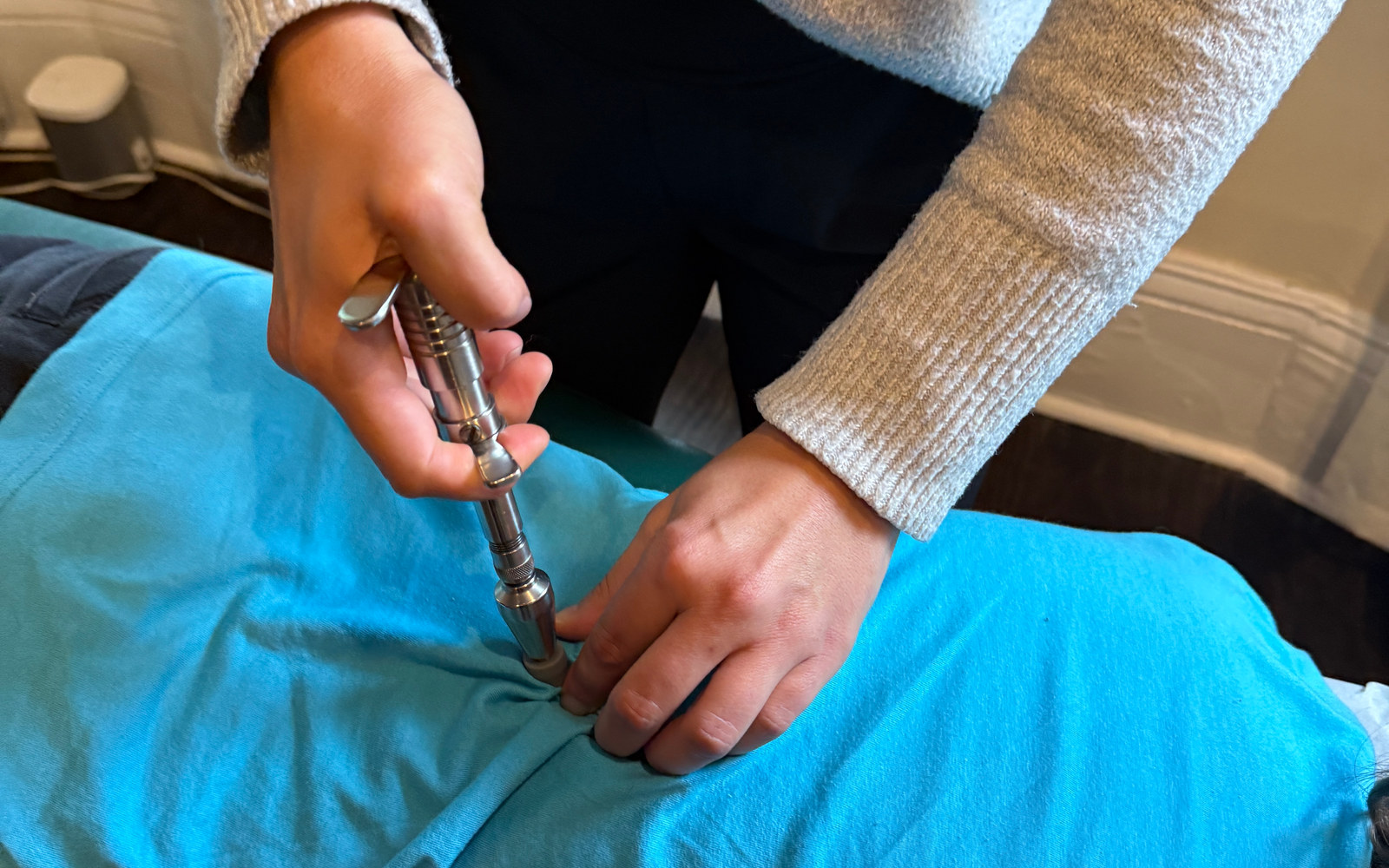
Some of the most effective work we do is low-force instrument or drop table technique with no noise whatsoever. For someone in an acute flare, or with a sensitive system, that is often the right choice. The cavitation is not the treatment.
What to Do Instead When Your Neck Feels Stuck
None of these are a substitute for finding out why it keeps happening, but they will get you through the afternoon without twisting your own head.
- Move it gently through range instead of forcing the end. Slow, small rotations and side bends, well short of the point where it wants to pop.
- Work the muscles rather than the joint. A few minutes on the upper trapezius and the base of the skull relieves more of that stuck feeling than a crack does.
- Change your screen height. If your monitor is below eye level, your neck is loaded all day. This single change undoes more tightness than any stretch.
- Check your pillow. Your head should sit level with your spine. Seven hours a night in a bad position is a much bigger input than anything you do in the daytime.
- Breathe out slowly for six counts, a few times. Some of that tightness is elevated resting muscle tone from a nervous system that has not stood down. Breathing changes it measurably.
Questions We Get Asked About This
Will cracking my own neck cause arthritis?
There is no good evidence that self-cracking causes arthritis. What it can do is reinforce an imbalance, where already-mobile segments take more and more of the movement while a restricted one stays stuck. That pattern is worth addressing on its own terms, without needing arthritis as a scare story.
Why can I crack my neck over and over in a row?
Because you are moving different joints each time. A joint that has just cavitated needs roughly twenty minutes before the gas redissolves and it can pop again. Repeated cracking within a few minutes is a good clue that the movement is not targeted at the segment that actually needs it.
Is the popping sound during an adjustment the same thing?
The sound is the same physical event. The difference is that an adjustment is aimed at one identified joint in one direction with a controlled force, after an examination. And plenty of effective adjustments make no sound at all, particularly the low-force techniques we use with babies, seniors and anyone in an acute flare.
My neck feels better after I crack it. Is that not proof it worked?
It is proof that it felt better, which is real but temporary. The relief comes largely from a burst of sensory input rather than from a lasting mechanical change, which is why it returns within minutes. If the effect lasted, you would not need to repeat it a dozen times a day.
Where This Usually Leads
Most people who ask us about self-cracking turn out to have one of two things going on. Either a restricted upper cervical segment that has been quietly stuck for years, or a load problem from a desk, a phone and a pillow that keeps recreating the tightness no matter what they do at the end of the range.
Both are straightforward to identify, and both respond well. Reading about it will only get you so far, though, because the whole point is finding out which segment is actually restricted in your neck rather than in general.
Curious which segment is actually stuck?
A discovery visit includes a full consultation, INSiGHT nervous system scans and imaging if your history calls for it. You leave knowing what is restricted and what to do about it, with no obligation to continue.
Dr. Amanda Burns is the founder of Even Flow Chiropractic on Main Street in Woodstock, Georgia. She earned her Doctorate of Chiropractic at Life University and practises nervous-system focused, family-centred care. This article is general information and not a substitute for an examination.
