
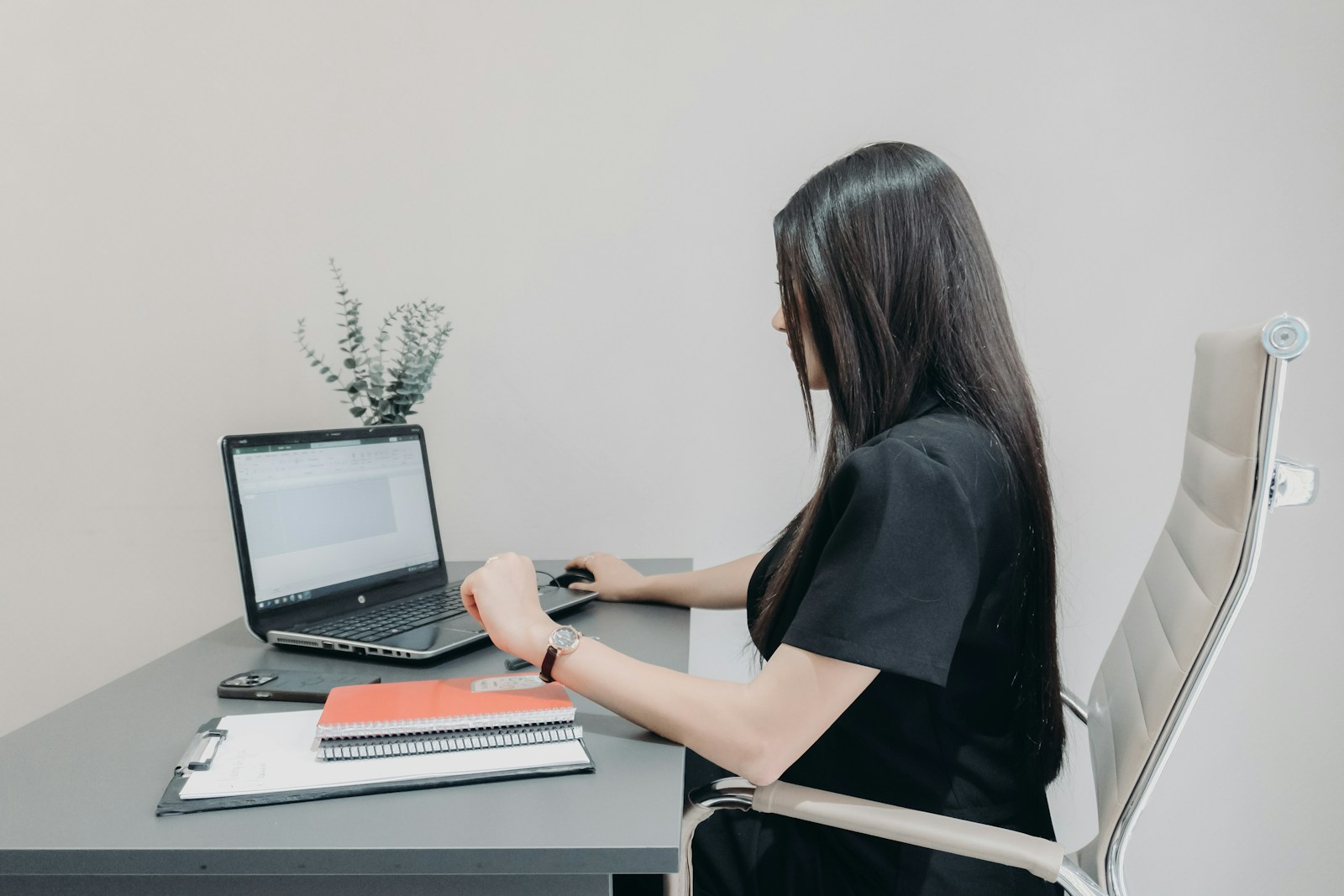
Somewhere between your late twenties and your mid thirties, a normal working week starts leaving marks. The ache across the top of your shoulders by four in the afternoon. The stiffness when you reverse out of a parking space. The headache that arrives on Thursdays and never on Sundays.
People usually ask us to fix their posture, as though it were a single thing they had been doing wrong. It is more useful to think about load. Your neck and back are not being damaged by sitting. They are being asked to hold one position for eight hours with almost no variation, and tissue that is loaded without variation gets unhappy.
Why Does Desk Work Hurt Your Neck and Back?
Three things happen when you settle into a laptop for a long stretch, and each one has a mechanical consequence.
Your head drifts forward
Look at where your screen sits. If it is below eye level, and on a laptop it always is, your head tilts down to meet it. Every degree forward means the muscles at the back of your neck work harder to stop your skull falling toward your chest. They are not designed to work continuously, and they let you know about it.
Your arms hang unsupported
If your forearms are not resting on something, your shoulder muscles are holding the entire weight of your arms all day. That is a substantial and completely unnecessary load, and it shows up exactly where people point when they say the top of their shoulders hurts.
Your mid-back stops rotating
The thoracic spine is built to rotate and extend. A day facing directly forward removes both, so segments stiffen and the muscles around them take over as stabilisers. This is why the ache between the shoulder blades is so common in desk workers, and why it keeps coming back after a massage. Our page on mid-back pain covers that cycle in more detail.
The Six Changes That Actually Help
These are in order of how much difference they make, not how easy they are. The first three are worth more than the rest combined.
- Get the top of your screen to roughly eye level. On a laptop this means a stand, a monitor, or a stack of books and an external keyboard. This single change does more for neck pain than any stretch you will find online.
- Support your forearms. Chair arms at desk height, or the desk itself. Your shoulders should be able to do nothing while you type.
- Interrupt the position every thirty minutes. Not a workout. Stand up, look out of a window, roll your shoulders, sit back down. The interruption is the active ingredient, not the movement you choose.
- Get your feet flat and your hips slightly above your knees. A footrest or a lower chair. This stops you sliding into a slump that your lower back then has to hold.
- Move your mouse closer. Reaching forward and out for a mouse all day rotates your shoulder and loads one side of your neck more than the other. Most one-sided desk pain has a mouse behind it.
- Take calls on speaker or a headset. Cradling a phone against your shoulder is the single worst thing most people do to their necks, and it is entirely avoidable.
Two things that help less than people expect
A standing desk on its own. Standing still for eight hours is a different fixed position, not a solution. Standing desks help when you alternate, which means actually alternating rather than owning the desk.
Sitting up straight. Holding a rigid upright posture is muscular work, and nobody sustains it past about ninety seconds. Aim for supported and variable rather than upright and effortful.
What About Stretching?
Stretching feels good and it has a place, but it is worth being clear about what it does. Pulling on a muscle that is working overtime gives you a few minutes of relief. It does not change why the muscle was working overtime, which is the position and the load.
If you only have two minutes, spend it on the mid-back rather than the neck. Sit tall, hands behind your head, and gently extend backwards over the chair back a few times. That restores the extension your day removed, and the neck usually feels better as a result even though you did nothing to it directly.
When It Is More Than Your Desk
Worth getting assessed rather than rearranging furniture
- Pins and needles, numbness or weakness travelling into an arm or hand
- Pain that wakes you at night or is present before you have done anything
- Headaches more than a couple of times a week, particularly starting at the base of the skull
- Pain that has not shifted after several weeks of a genuinely better setup
- A history of a collision or a fall on the head or neck, even years ago
- Dizziness or visual changes with neck movement, which needs assessment promptly
The reason this list matters is that a desk is a load, not a diagnosis. If a specific segment has lost motion, or a nerve root is irritated, better ergonomics will reduce the aggravation without resolving the underlying restriction. That is the difference between managing something and changing it.
How We Approach It Here
The first visit is about finding out which of the two you are dealing with. We use a full history plus INSiGHT nervous system scanning, which includes surface EMG. That last one is genuinely useful for desk pain, because it shows which muscles are holding tension at rest rather than only when you are working. People are frequently surprised by how asymmetric their pattern is.
From there, care usually combines specific adjustments to restore the motion the week keeps removing, massage therapy for the muscles that have been compensating, and the two or three changes to your setup that matter most for your findings. Not a printed list of twenty exercises, which nobody does past the first week.
Questions We Get Asked
How long before a better desk setup makes a difference?
Most people notice something within a week or two, usually that the late-afternoon ache arrives later or not at all. If several weeks of a genuinely better setup has changed nothing, the setup was not the whole problem and it is worth having the neck itself assessed.
Is my chair the problem?
Usually less than people hope. Screen height and forearm support matter more than the chair, and an expensive chair used in a bad setup is still a bad setup. Get those two right first, then judge whether the chair is holding you back.
Should I be worried about text neck damaging my spine?
Worried is the wrong frame. Sustained forward head position is a load, and load produces adaptation over years, including reduced neck curve and stiffer segments. That is worth addressing, and it is not a countdown to something catastrophic. See our neck pain page for what we actually find and what we do about it.
I work from home and cannot change much. What is the one thing?
Raise the screen. If you are on a laptop at a kitchen table, put it on a couple of books and use a separate keyboard. It costs nothing and it changes the position your neck holds for the next eight hours, which is the whole game.
Fixed the desk and it still hurts?
Then something in your neck or mid-back has lost motion, and rearranging furniture will not reach it. A discovery visit gives you scans, findings and a plan in writing.
Dr. Amanda Burns is the founder of Even Flow Chiropractic on Main Street in Woodstock, Georgia. She practises nervous-system focused, family-centred care. This article is general information and not a substitute for an examination.
